
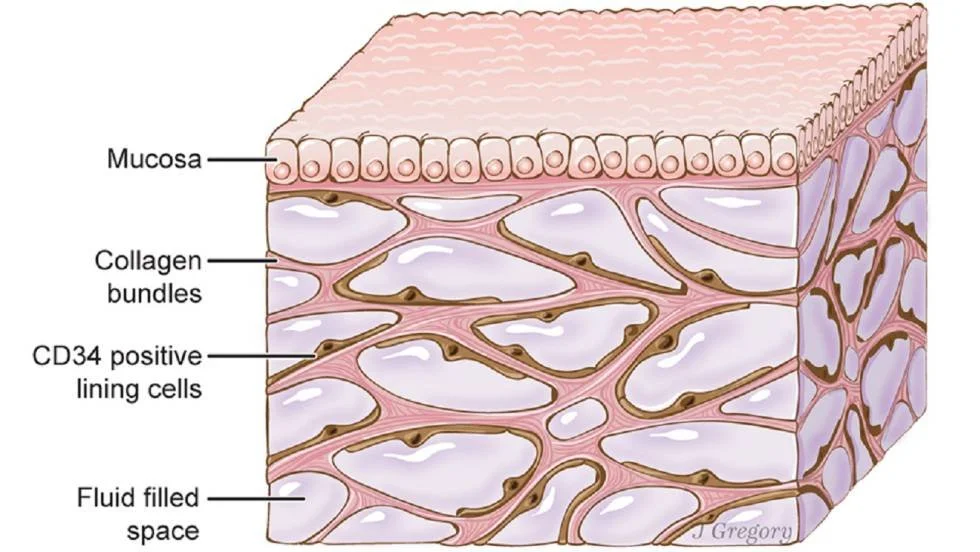
In 2015, two gastroenterologists at Mount Sinai Beth Israel Medical Center in New York City were using a cutting-edge imaging technique to examine a patient's bile duct for signs of cancer spread. What they saw stopped them cold. Instead of the solid, wall-like tissue layers they expected, the living tissue revealed something that looked, in the words of one researcher, like an "open, fluid-filled highway."
This was not supposed to be there.
By 2018, a full study was published in Scientific Reports by Benias, Carr-Locke, and pathologist Dr. Neil Theise of NYU Langone Health. Their findings described a body-wide network of fluid-filled, interconnected spaces woven through and between virtually every tissue and organ in the human body: beneath the skin, surrounding arteries and veins, lining the gut, the lungs, the urinary tract, and running through the fascia between muscles.
They proposed calling it the interstitium.
A Structure Hiding in Plain Sight
The reason the interstitium escaped notice for so long is almost poetically ironic: the very tools scientists used to look at tissue destroyed it before they could see it. The standard histology technique, developed in the early 1800s, involves fixing tissue in chemicals, dehydrating it, and slicing it into paper-thin sheets. This process collapses the fluid-filled spaces, turning a dynamic three-dimensional web into what appears to be a dense, inert wall with occasional lines in it — lines that researchers assumed were insignificant cracks.
When Benias and colleagues used probe-based confocal laser endomicroscopy (pCLE) — a technique that allows real-time microscopic imaging of living tissue without removing or processing it — the interstitium suddenly came into view. And once you could see it, as Theise noted, you couldn't unsee it.
What the researchers found was a structured latticework of collagen and elastin bundles, with fluid-filled spaces between them, lined by unusual spindle-shaped cells that expressed both connective tissue and endothelial markers. These spaces weren't random or chaotic — they were organized, interconnected, and continuous. A later 2021 study by Theise and colleagues in Communications Biology provided evidence that these interstitial spaces may be continuous across different tissue and organ boundaries — meaning the network potentially links the entire body into one connected fluid system.
The question of whether the interstitium constitutes a new "organ" quickly became a media flashpoint. Theise has been careful to clarify the distinction. "It's actually not an organ. It's a system," he has said — though by functional and structural criteria, it rivals or surpasses several organs we've accepted for centuries.
What matters more than the taxonomy is the function: the interstitium may play a central role in how fluids, cells, signaling molecules, and — intriguingly — disease move through the body. Researchers have hypothesized roles in cancer metastasis (tumor cells may hijack interstitial channels to spread), inflammatory disease, tissue repair, and the regulation of lymphatic drainage.
Enter the San Jiao: TCM's "Organ Without Form"
Traditional Chinese Medicine describes twelve primary organ systems. Eleven of them match up to anatomical structures recognizable in Western medicine: the Lung, Heart, Liver, Spleen, Kidney, and so on. But the twelfth has puzzled practitioners and scholars for two millennia.
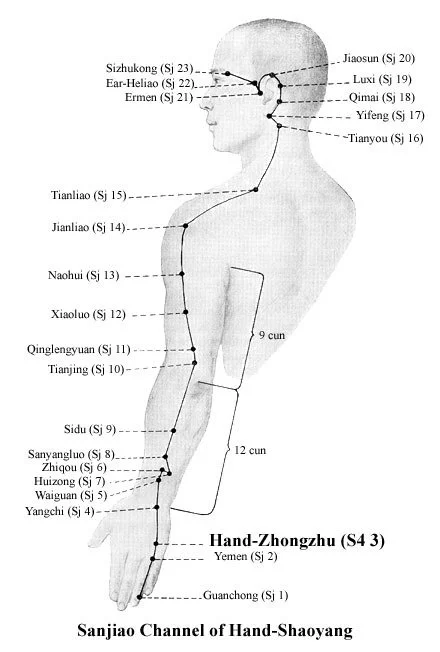
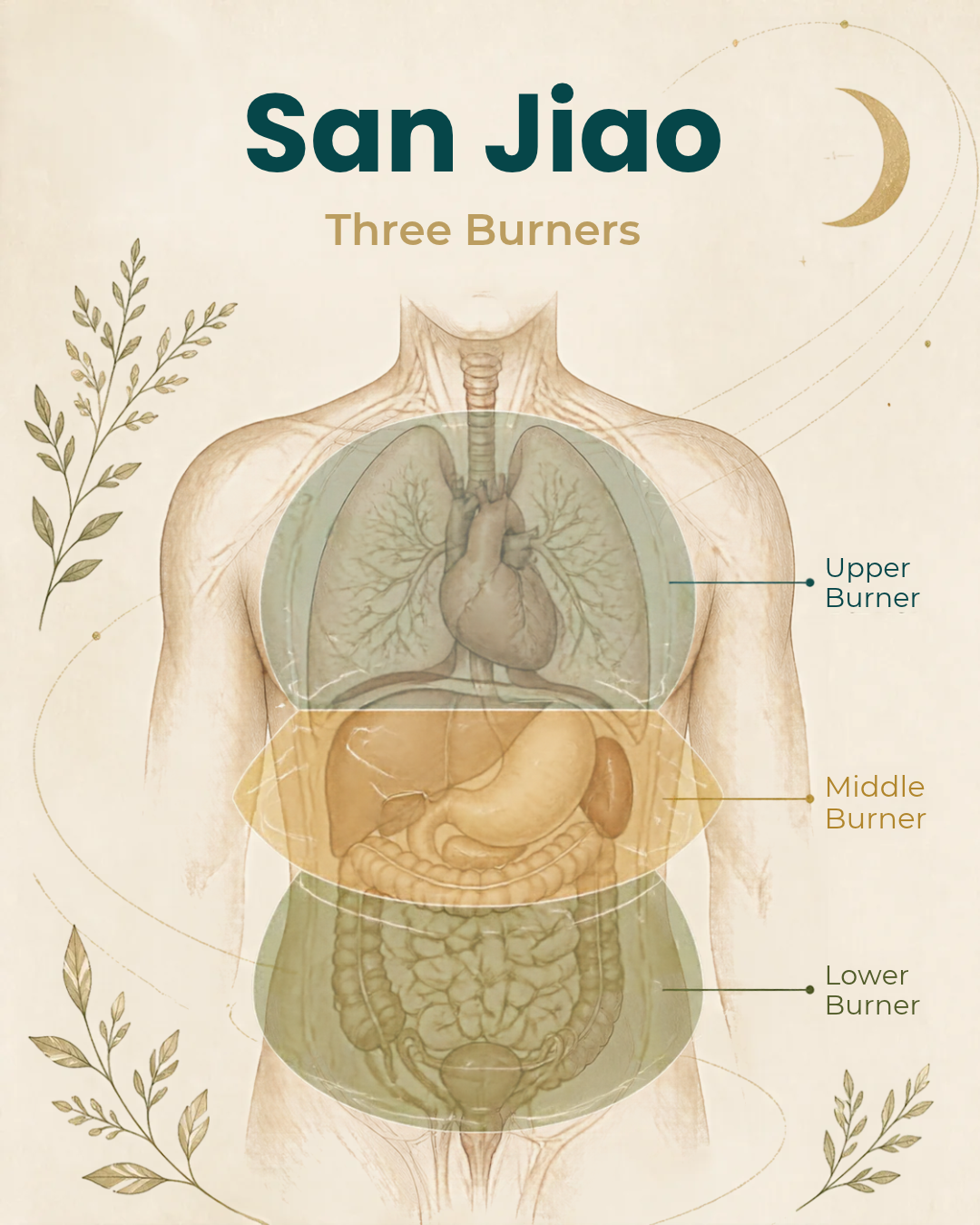
It is called the San Jiao — translated as the Triple Burner, Triple Warmer, Triple Heater, or Triple Energizer. Ancient texts acknowledge the paradox directly: the San Jiao is described as "an organ with a name but no form." Classical literature, including the Nanjing (Classic of Difficulties), describes it as governing the movement of water throughout the body, dividing the body cavity into functional compartments (Upper, Middle, and Lower Burners), and coordinating communication between all other organ systems. The Najhing states plainly: "The water-ways originate from there."
For centuries, Western-trained anatomists dismissed the San Jiao as metaphorical — a functional concept that ancient physicians had mistakenly reified as a physical thing. How could there be an organ everywhere and nowhere? How could something govern the entire body's fluid metabolism without having a discrete, locatable structure?
The interstitium may be the answer.
Dr. Louis Gordon, a Chinese Medicine practitioner who has spent decades investigating the San Jiao, argued in his work that the interstitium is precisely the physical substrate that the San Jiao was always describing. The parallel is striking: the interstitium is found throughout the body, has no single location, governs fluid distribution, connects all organs and tissues, and constitutes what might be called an omnipresent metasystem rather than a discrete structure. Gordon also draws attention to a specific TCM subsystem called the Cou Li — described in classical texts as a fatty membrane network of minute vesicles that contains body fluids and irrigates the entire body, from the deep interior to the skin — as a likely direct reference to interstitial tissue.
The Meridians and the Matrix
The San Jiao connection is the most dramatic parallel, but it isn't the only one.
The interstitium and its collagen architecture have also sparked a new line of inquiry into the physical basis of the meridian system — the pathways along which acupuncture points are mapped and Qi is said to flow. For decades, the meridians have been among the most contested elements of TCM, precisely because no discrete anatomical structure corresponding to them had been identified.
Several converging lines of evidence are now making this harder to dismiss.
First, studies have shown that electrical impedance — the resistance a tissue offers to electrical current — is measurably lower along meridian pathways than in surrounding tissue. Lower impedance means greater electrical conductivity: the tissue along meridians appears to behave differently from the tissue around it.
Second, collagen — the primary structural protein of the interstitium — has been shown to possess piezoelectric properties, meaning it can convert mechanical pressure into electrical signals. When an acupuncture needle is inserted and manipulated, it mechanically deforms the surrounding connective tissue. This mechanical force could, in theory, be transformed into electrical signals through the piezoelectric behavior of interstitial collagen, propeling along the collagen fiber network in ways that correspond to the meridian pathways.
Third, the anatomical distribution of acupuncture points correlates strongly with fascial planes, connective tissue compartments, and — as researchers are now beginning to note — interstitial pathways. The needle isn't simply reaching a muscle or nerve. It may be engaging a system that runs through the entire body's connective tissue matrix.
Researcher Johnson J.H. Wang, in a 2022 paper in the Journal of Clinical Trials, argued that the interstitium's discovery provides the "logic bridge" TCM has long lacked in Western scientific dialogue — a physical substrate for Qi flow that is grounded in conventional anatomy, not metaphysics.
What This Means (and What It Doesn't)
It's worth pausing here for intellectual honesty, because this territory attracts both genuine researchers and enthusiastic oversimplification.
The interstitium is real. Its body-wide distribution is documented. Its fluid-dynamic functions are plausible and under active investigation. The collagen piezoelectric properties are established in vitro. The electrical impedance differences along meridian lines have been reproduced in limited studies.
What is not yet established — and this matters — is a definitive causal chain: proof that interstitial fluid flow is Qi, that acupuncture needles signal specifically through piezoelectric collagen, or that the meridian system maps precisely and completely onto interstitial architecture. These remain compelling hypotheses, not settled science. The interstitium is a young discovery and its full functional role in health and disease is still being worked out.
What we can say is this: the conversation between East and West just got significantly more interesting.